
Key Takeaways
- Genuine sea glass is naturally weathered glass, not a naturally occurring gemstone.
- Mature pieces usually take decades to develop rounded edges and a frosted surface.
- White, brown, and green are generally common; colors such as red and orange are much less common.
- Color rarity varies from beach to beach because local history matters.
- “Sea glass” and “beach glass” are sometimes used interchangeably, although collectors may distinguish saltwater from freshwater finds.
- Machine-tumbled craft glass can look convincing, so no single visual test guarantees authenticity.
- A rare color alone does not automatically make a piece valuable.
Table of Contents
- What exactly is sea glass?
- Where does sea glass come from?
- How is sea glass formed?
- How long does sea glass take to form?
- Sea glass vs. beach glass vs. tumbled glass
- How can you identify genuine sea glass?
- What do sea glass colors mean?
- Is sea glass rare or valuable?
- Common sea glass myths
- Related questions
- FAQ
What Exactly Is Sea Glass?
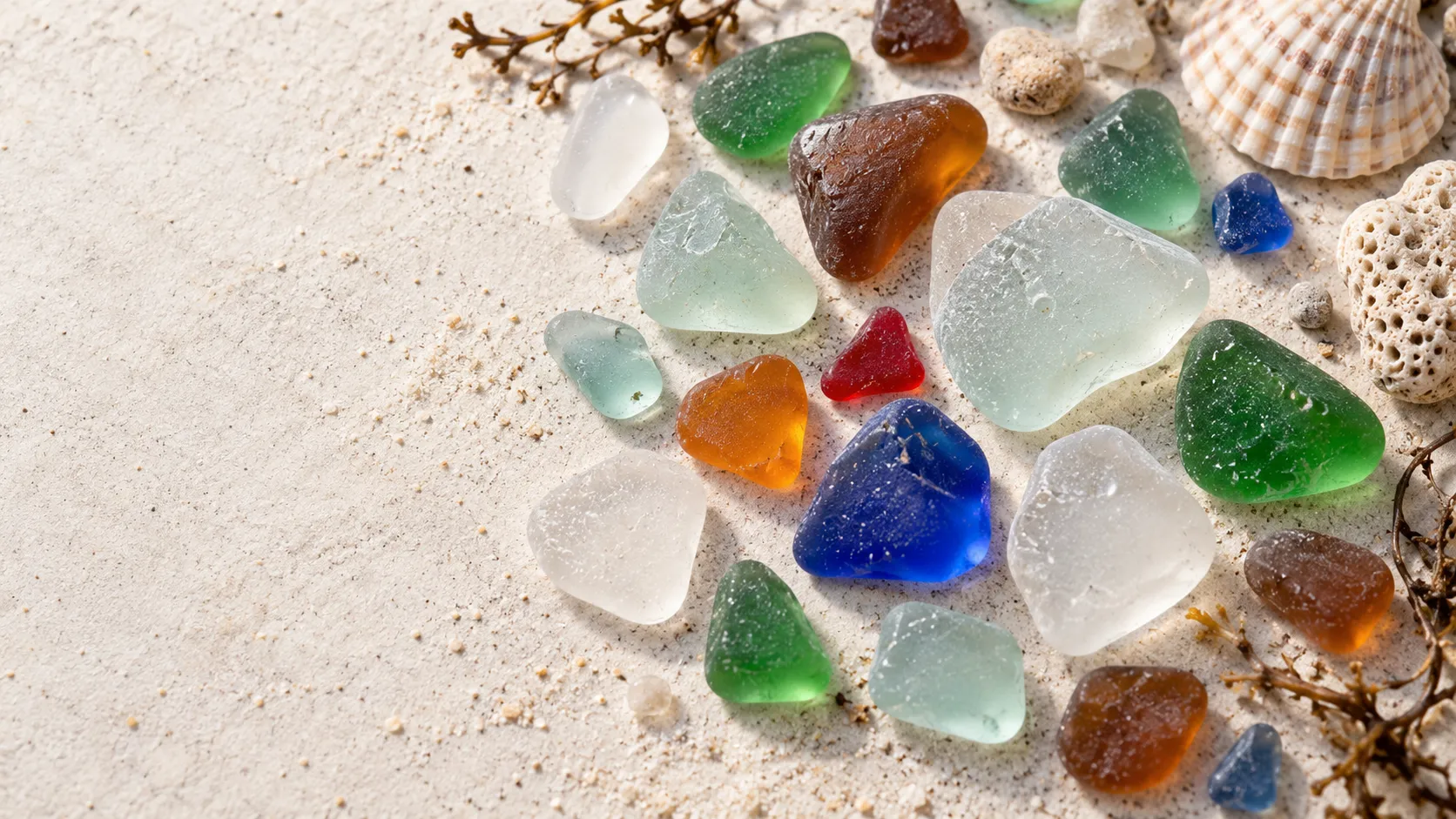
Sea glass is glass that has been physically and chemically weathered along a shoreline until its sharp edges become rounded and its glossy surface develops a soft, frosted appearance.
The important word here is glass.
Sea glass is not a mineral growing beneath the ocean. It did not begin life as a mysterious crystal.
Most pieces started as something wonderfully ordinary: a soda bottle, beer bottle, medicine jar, drinking glass, window pane, plate, cosmetic container, or other manufactured glass object.
Then history happened.
Some glass was discarded when coastal dumping was common. Some came from ships. Some washed out of old landfill sites. Some was simply broken near the shoreline.
After enough time in the water, the original object becomes difficult—or occasionally wonderfully possible—to recognize.
That is a big part of the hobby's appeal. A cloudy green pebble in your hand might once have been somebody's bottle decades ago.
Sea glass is, quite literally, human history edited by water.
Where Does Sea Glass Come From?
Historically, enormous quantities of glass were used for bottles and containers long before plastic packaging became widespread.
Coastal communities also treated waterways very differently from the way we do today.
Household rubbish, industrial waste, broken tableware, and bottles sometimes ended up directly in rivers, harbors, and oceans.
That unfortunate environmental history created many of today's famous sea-glass hunting areas.
Historic ports, former coastal dumps, old resorts, industrial areas, shipping routes, and glass-manufacturing regions can therefore produce very different finds.
This is why location matters so much.
A beach near an old bottleworks may contain colors that would be extraordinarily unusual somewhere else. A shoreline near an old beverage industry may produce endless greens and browns.
There is no universal sea-glass vending machine hiding under the ocean. Every beach has its own backstory.
Historical bottle researchers also use manufacturing marks, bottle shapes, seams, bases, colors, and other clues to estimate what old glass once was and when it may have been produced.
How Is Sea Glass Formed?
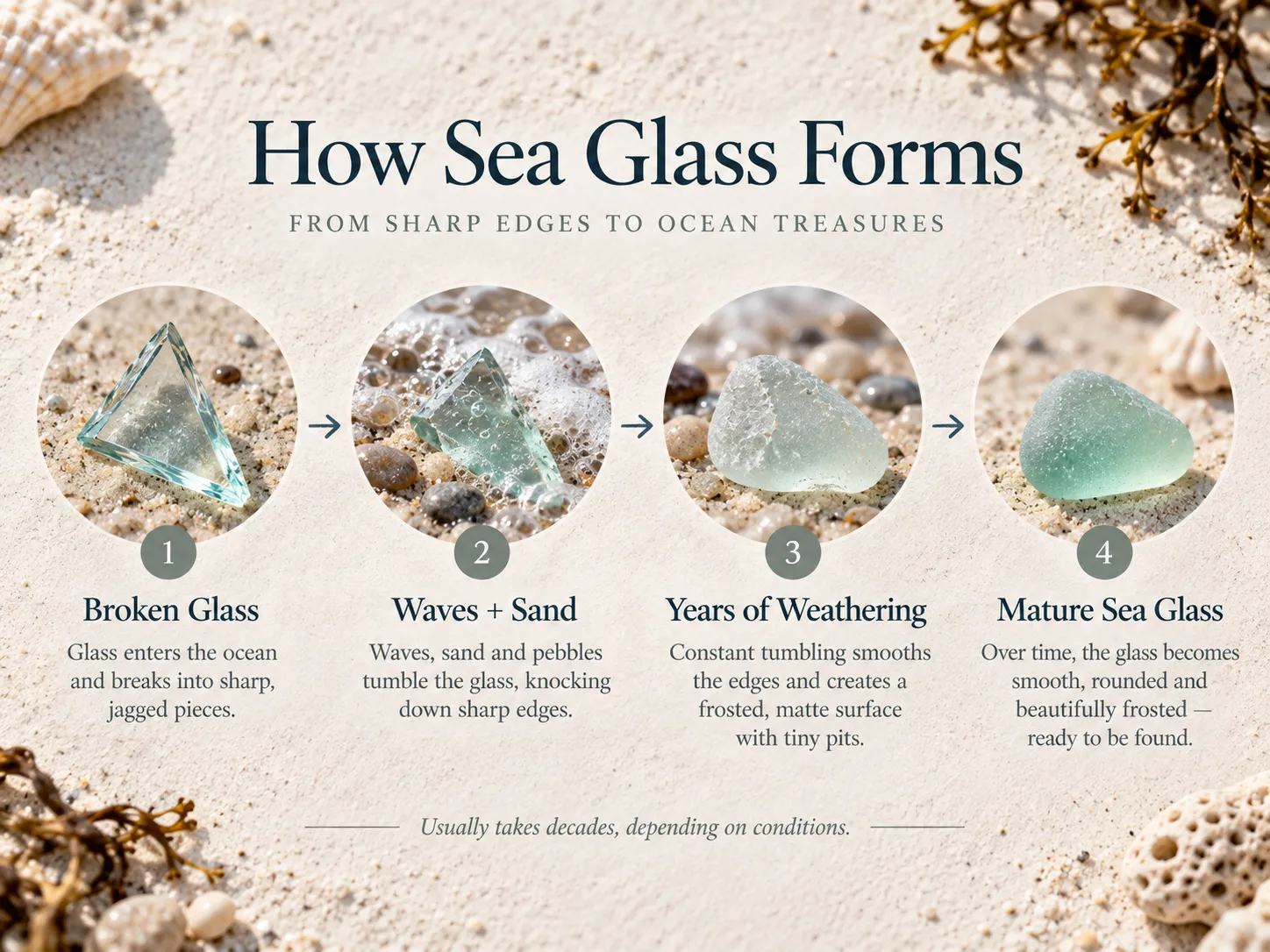
Sea glass is produced by a combination of mechanical abrasion and chemical weathering.
1. The glass enters the water
A bottle, jar, dish, or other glass object breaks into fragments.
Freshly broken glass is still exactly what it sounds like: broken glass. It may be sharp, glossy, and dangerous.
2. Waves move it
Currents and waves repeatedly move the fragment through sand, gravel, shells, and rocks.
This gradually chips and rounds the edges.
3. The surface becomes weathered
At the same time, prolonged exposure to water changes the outer surface of the glass.
The shiny factory finish becomes duller, etched, and eventually frosted.
4. Time keeps working
The piece may be buried for years, exposed again by storms, carried elsewhere, buried again, and eventually deposited on a beach.
The result is what collectors recognize as mature sea glass: rounded edges, a matte surface, irregular wear, and a shape that looks nothing like fresh broken glass.
Both physical and chemical weathering are part of the process.
How Long Does Sea Glass Take to Form?
There is no stopwatch inside a piece of sea glass.
A commonly cited estimate is roughly 20 to 40 years or more for glass to develop the characteristic texture associated with mature sea glass.
Some pieces may have spent considerably longer—potentially many decades or more—in the water.
But “20 years” should not be treated like a birthday.
Formation speed depends on things such as:
- wave energy;
- glass thickness;
- shoreline geology;
- sand and gravel size;
- water chemistry;
- how long the glass remains buried;
- and how frequently it moves through active surf.
A thick chunk protected in calm sediment might change slowly. A thinner fragment constantly tossed across a rough pebble beach may weather much faster.
Age therefore cannot be reliably determined from frosting alone.
Sea Glass vs. Beach Glass vs. Tumbled Glass
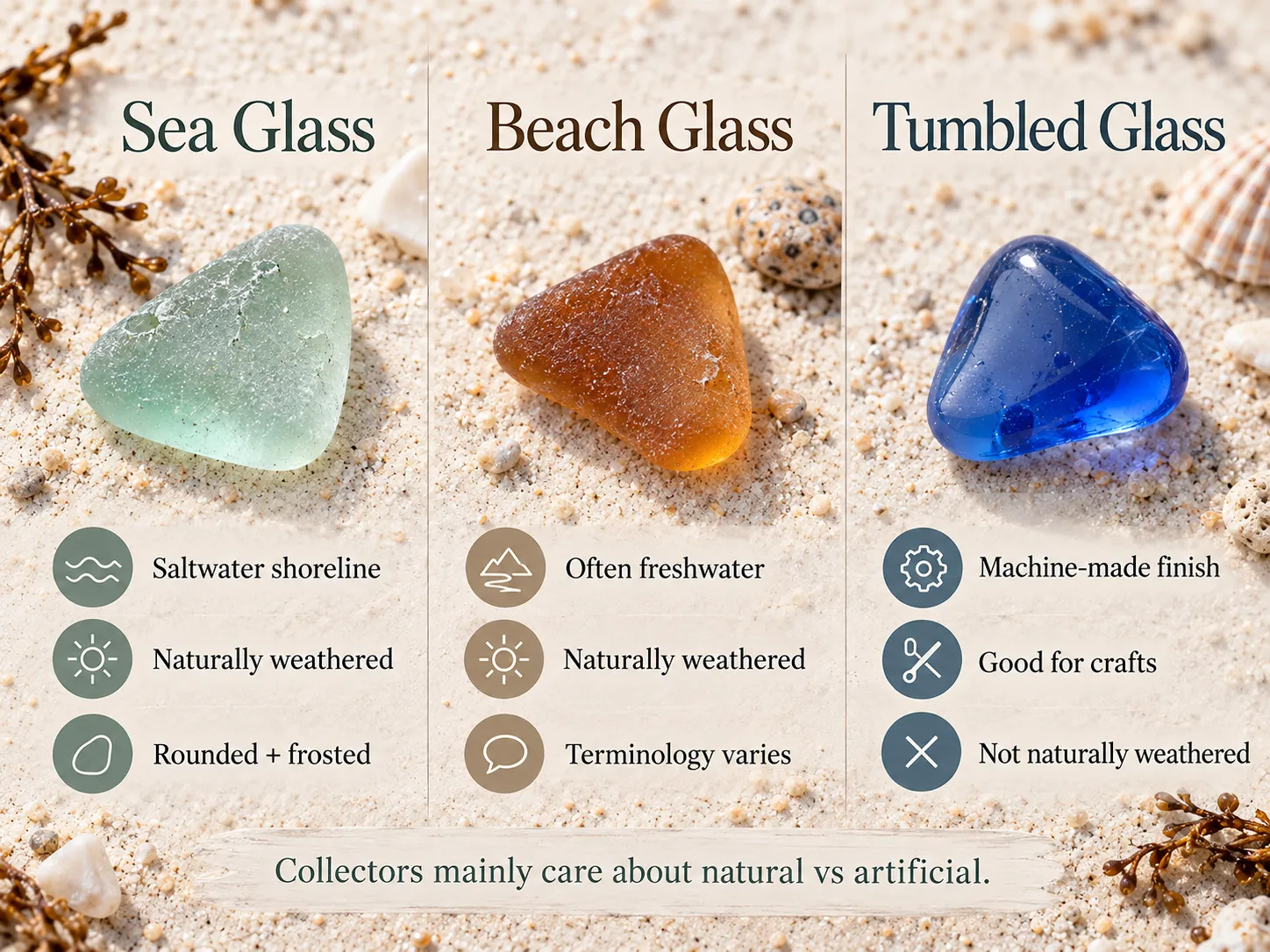
| Term | Typical Meaning | Naturally Weathered? | Collector Note |
| Sea glass | Glass naturally weathered on saltwater shorelines | Yes | Usually strongly frosted and rounded |
| Beach glass | Often freshwater shoreline glass, although sometimes used as a general synonym | Yes | Terminology varies between collectors |
| Tumbled / craft glass | Glass mechanically processed to imitate sea glass | No | Perfectly fine craft material, but should not be sold as genuine sea glass |
| Fresh broken glass | Recently broken glass found on a beach | No mature weathering | Remove carefully; it is not collectible sea glass yet |
Collector terminology is not completely universal.
Some people reserve “sea glass” for ocean finds and “beach glass” for freshwater pieces, while others use both terms more loosely.
Even established sources acknowledge that the names are often used interchangeably.
The more important distinction is natural versus artificial.
How Can You Tell Genuine Sea Glass From Fake?
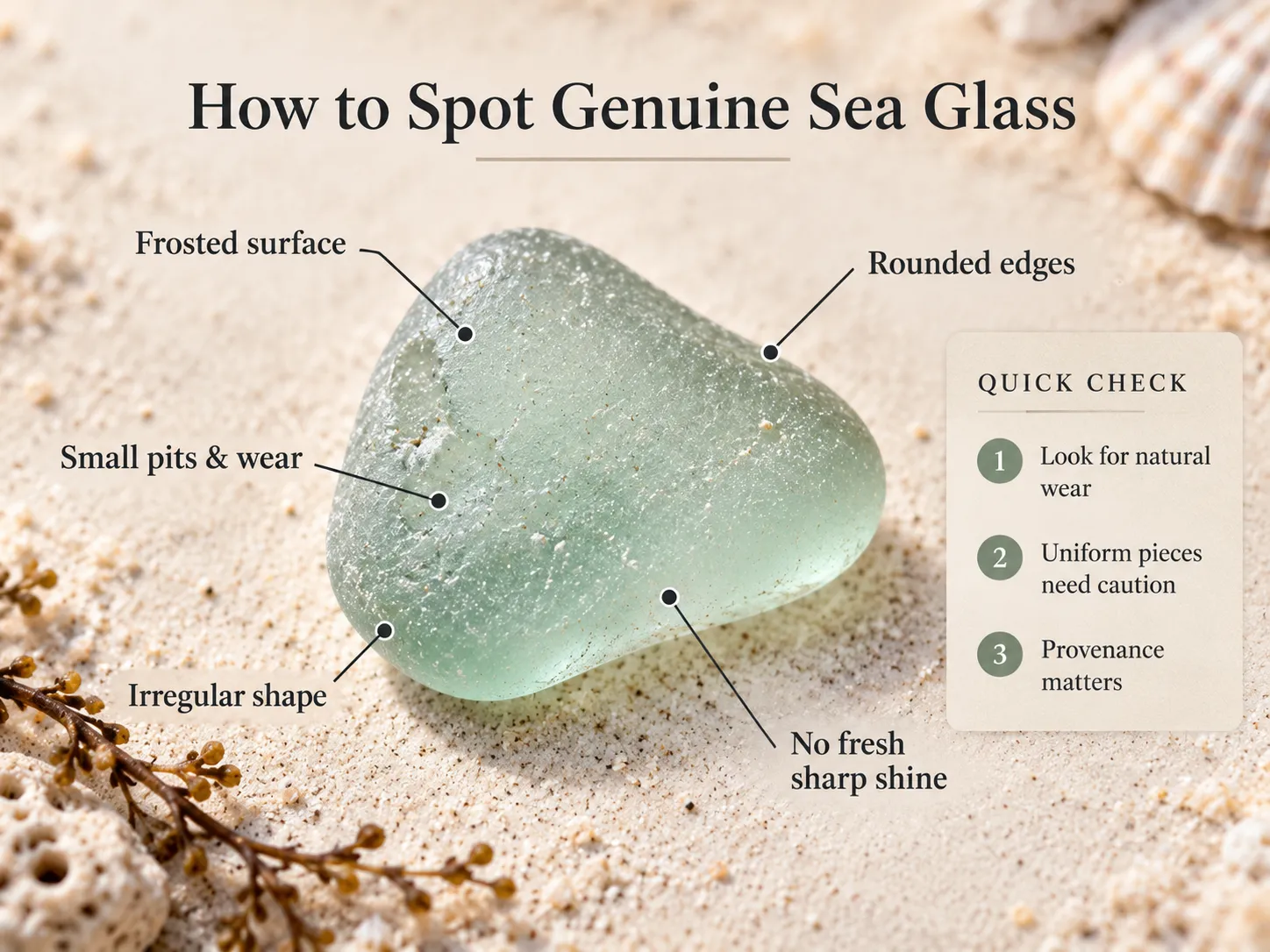
This is where beginners occasionally discover that the ocean is not the only thing capable of owning a rock tumbler.
Artificially tumbled glass can be extremely convincing, particularly in photographs.
The International Sea Glass Association warns that authenticity can sometimes be difficult to determine visually, especially when buying online.
Seller provenance and transparency therefore matter just as much as surface appearance.
The KibToys Five-Point Collector Check
Use these together rather than relying on one magical test.
1. Inspect the surface.
Genuine pieces usually show irregular frosting, pits, wear, and small impact marks rather than a perfectly identical finish across an entire batch.
2. Look at the edges.
Well-weathered sea glass normally has comfortably rounded edges. Sharp edges suggest immature or recently broken glass.
3. Compare the shapes.
Nature is terrible at producing twelve perfectly identical pendants.
Highly uniform pieces with matching shapes, sizes, and colors deserve closer examination.
4. Look for history.
Embossing, curved bottle walls, thick bases, seams, decorative patterns, and unusual shapes may offer clues about the original object.
5. Ask where it came from.
For expensive collector pieces, provenance matters. A trustworthy seller should be able to explain how or where the glass was collected rather than merely calling everything “authentic ocean treasure.”
No single point proves authenticity. Think of it as evidence stacking.
What Do Sea Glass Colors Mean?
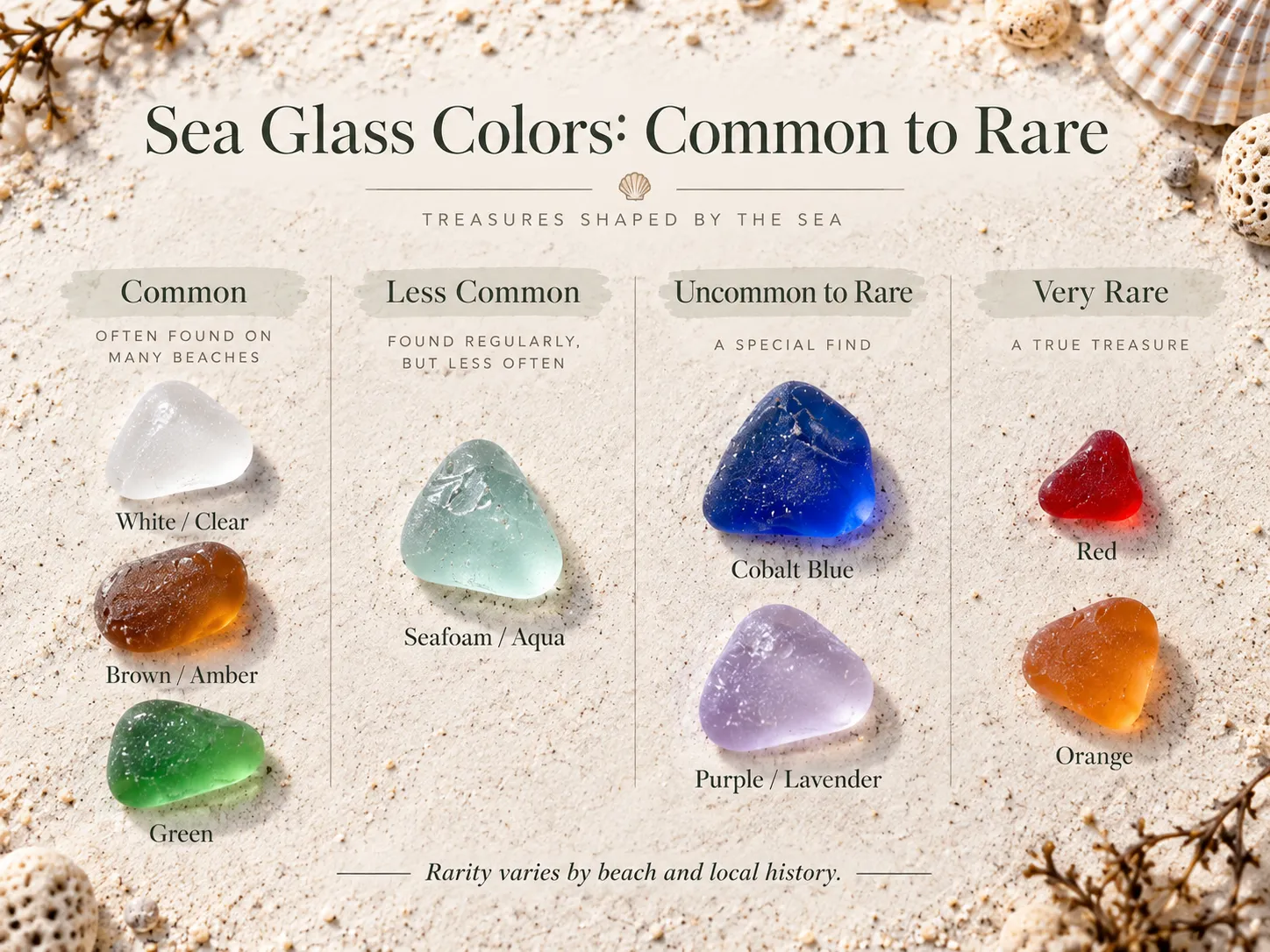
Most sea-glass colors are leftovers from the original object.
| Color | Relative Occurrence | Possible Original Sources |
| Clear / frosted white | Common | Bottles, jars, windows, tableware |
| Brown / amber | Common | Beverage, medicine, liquor bottles |
| Kelly green | Common | Beer, soda, wine and beverage bottles |
| Seafoam / aqua | Less common | Bottles, jars, windows, medicine containers |
| Cobalt blue | Uncommon to rare | Medicine, cosmetic and decorative glass |
| Purple / lavender | Rare in many locations | Decorative glass or altered older glass compositions |
| Red | Very rare in many locations | Decorative glass, signal lights, tableware |
| Orange | Extremely rare in many locations | Decorative glass and some vehicle or marine signal glass |
These categories are relative, not universal laws.
Beachcombing Magazine notes that rarity charts are largely based on historic patterns of glass production.
If a particular region once had a factory producing an unusual color, that color may be surprisingly common on one beach while remaining extremely difficult to find elsewhere.
So if someone announces that your orange piece is “exactly one in 10,000,” feel free to enjoy the excitement—but keep one eyebrow politely raised.
Is Sea Glass Rare or Valuable?
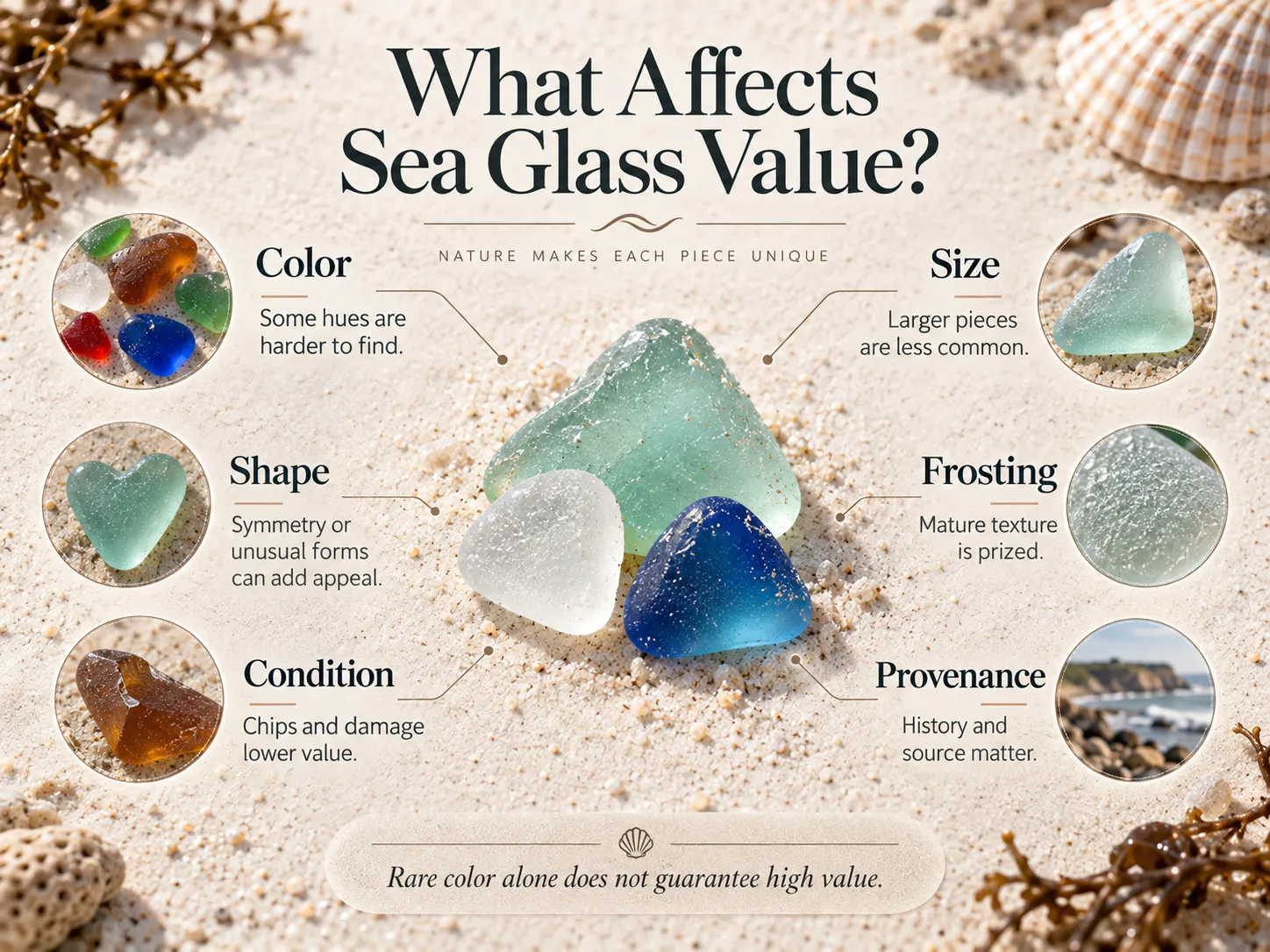
Some is.
Some absolutely is not.
Common white, brown, and green fragments can be plentiful on productive beaches. Collector-grade pieces become more interesting when several qualities overlap:
color + size + shape + frosting + condition + age clues + provenance + historical features
For example, an unusual piece retaining part of an embossed bottle mark may interest a collector even if its color is not exceptionally rare.
Likewise, a rare color with poor weathering, sharp edges, or questionable provenance may be less desirable.
Rarity should therefore never be reduced to color alone.
And because modern waste management, beach cleanup, and the transition away from glass packaging have reduced the amount of older glass entering many coastlines, mature sea glass has become harder to find at numerous locations.
Smithsonian documented this changing supply dynamic years ago, and collectors continue to observe it today.
Examples: Reading the Story Inside a Piece
Imagine finding three pieces during the same walk.
Piece A: Frosted Brown
Rounded, well-frosted, moderately thin.
The glamorous answer?
Probably an old beverage or medicine bottle.
Not every artifact belonged to a pirate captain. Sometimes history drank beer.
Piece B: Thick Cobalt Blue
Deep blue, heavily rounded, noticeably thicker.
Now things get interesting.
Cobalt glass has historically been used in medicine and cosmetic containers, among other products. The thickness and curvature might give additional clues.
Piece C: Nearly Black
Hold it against strong light.
Some apparently black historic glass is actually extremely dark olive, amber, or purple glass.
Older bottle identification resources confirm that so-called “black glass” can be intensely dark-colored glass rather than literally black glass.
Suddenly the flashlight on your phone has become archaeological equipment.
Sort of.
Common Sea Glass Myths
“Any glass found on a beach is sea glass.”
No.
If it still has dangerous sharp edges and a shiny fresh surface, it is broken glass on a beach.
“If it looks frosted, it must be real.”
No.
Tumbling, sandblasting, and chemical treatments can imitate parts of the appearance.
“Rare color means expensive.”
Not automatically.
Condition, shape, provenance, size, historical features, and collector demand also matter.
“You can make genuine sea glass at home.”
You can make tumbled glass at home.
It can be beautiful and useful for crafts. It simply shouldn't be represented as naturally ocean-weathered sea glass.
“We should throw glass into the ocean so future generations have more.”
Absolutely not.
Please do not create tomorrow's beach hazard in the name of somebody's hypothetical 2076 jewelry collection.
Related Questions
Is sea glass a gemstone?
No. Sea glass is weathered manufactured glass, although collectors sometimes affectionately call attractive pieces “gems of the sea.”
Can sea glass come from shipwrecks?
Yes, some can. But ordinary household disposal, historical dumping, ports, industrial glass waste, and shoreline activity are also major sources.
Why is sea glass frosted?
Long-term abrasion and chemical weathering alter the original smooth glass surface, producing the matte texture collectors associate with mature sea glass.
Why are some colors rarer?
Because some glass colors were historically manufactured in much smaller quantities than clear, brown, or green container glass.
FAQ
What is sea glass in simple terms?
Sea glass is ordinary glass that has been naturally smoothed, rounded, and frosted by years of exposure to water, sand, rocks, and waves.
How long does it take sea glass to form?
Usually decades rather than months or a few years. Around 20–40 years is a commonly cited starting range, but conditions vary greatly.
What is the rarest sea glass color?
Orange and red are commonly placed among the rarest colors in collector guides. However, local glassmaking history can dramatically change rarity from one location to another.
Is blue sea glass rare?
Some shades are. Cobalt and certain unusual blues are significantly less common than typical clear, brown, or green bottle glass.
Can you sell sea glass?
Yes, where legally permitted. Genuine collector-grade sea glass is sold loose and in jewelry, crafts, displays, and collections. Always check local collecting laws before removing material from protected beaches.
Is beach glass the same as sea glass?
Sometimes the names are used interchangeably. Some collectors specifically use “sea glass” for saltwater pieces and “beach glass” for freshwater finds.
Author
Jackson — Founder of KibToys
Jackson founded KibToys around a lifelong habit of collecting cute, strange, satisfying, and conversation-starting objects—the sort of things that mysteriously multiply across a desk when nobody is looking.
For this guide, sea-glass claims were cross-checked against collector organizations, specialist publications, historical-glass resources, and current reference material rather than relying on product marketing claims.
Reviewed
KibToys Editorial Fact Check
Reference review includes material from the International Sea Glass Association, Beachcombing Magazine, Smithsonian Magazine, and the Society for Historical Archaeology.
Published
September 15, 2026
Last Updated
September 15, 2026
References
International Sea Glass Association — guidance on genuine, artificial and altered sea glass. Genuine, Artificial and Altered Sea Glass
Beachcombing Magazine — collector discussion of rarity charts and why rarity reflects historical glass production. The Rarity Chart – Dissected
Beachcombing Magazine — color origins and relative rarity. The Colors and Rarity of Sea Glass
Smithsonian Magazine — sea-glass history, collecting and changing supply. Sea Glass: The Search on the Shore
Society for Historical Archaeology — historic bottle identification and dating resource. Historic Glass Bottle Identification