
Key Takeaways
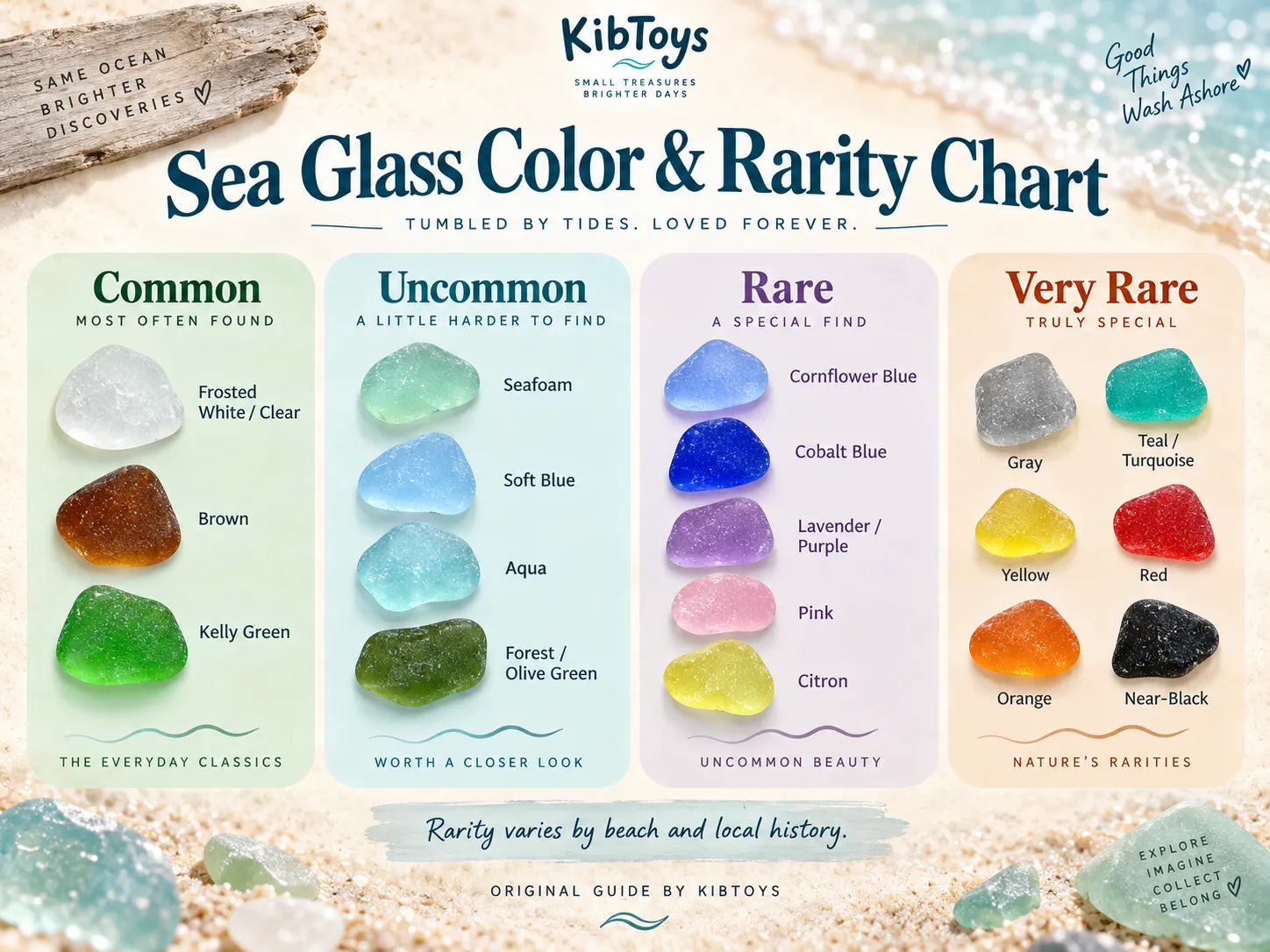
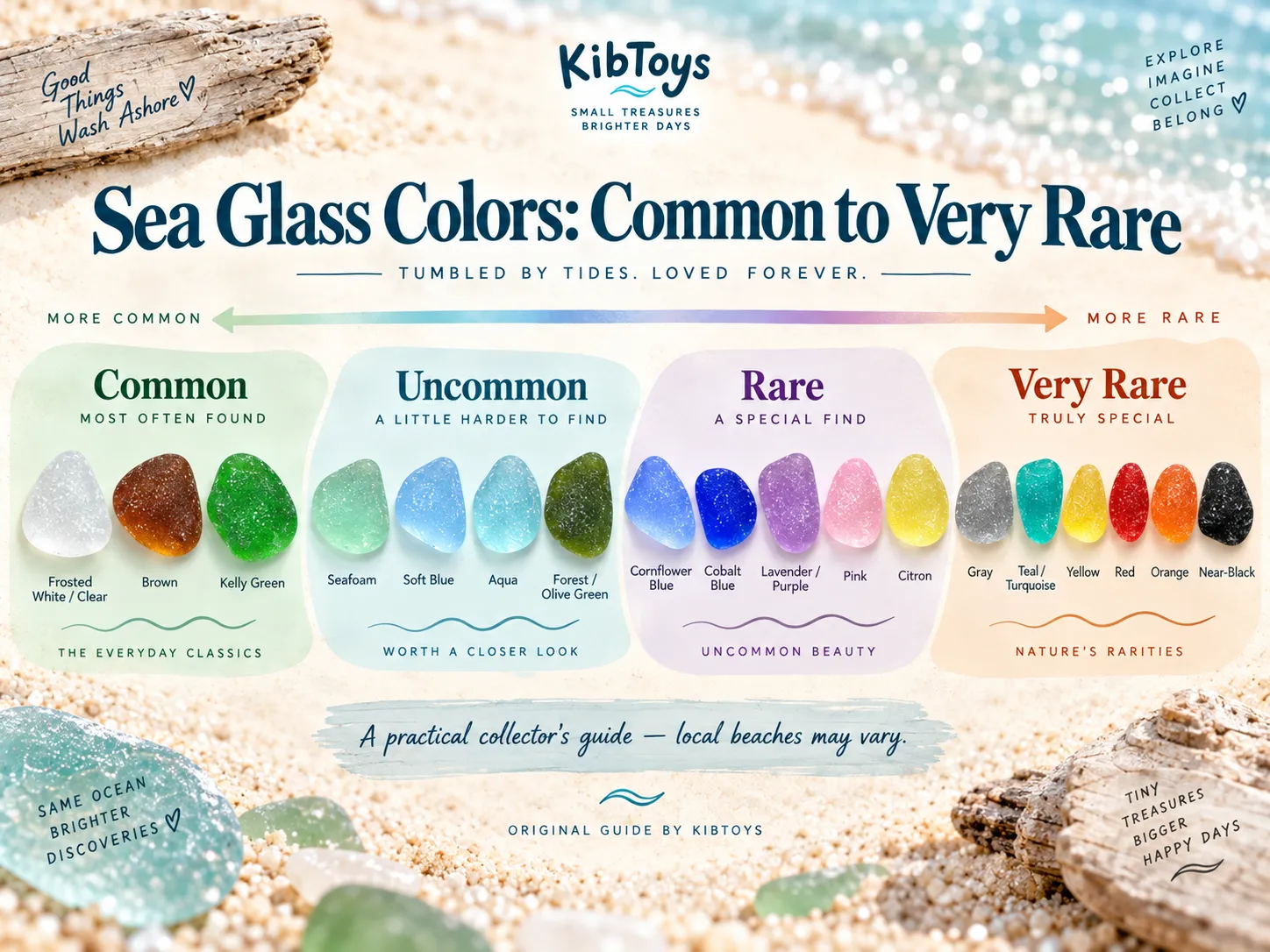
- White, brown, and kelly green are generally the most common sea glass colors.
- Seafoam, aqua, soft blue, forest green, and some amber shades are less common.
- Cobalt blue, cornflower blue, lavender, pink, citron, and unusual opaque colors are prized collector finds.
- Orange and red consistently appear among the hardest colors to find; yellow, teal, turquoise, gray, and near-black historical glass can also be exceptionally scarce.
- Rarity depends heavily on where the glass was found.
- Color alone cannot reliably prove age, authenticity, or value.
- If someone has 300 identical “ultra-rare orange sea glass” pieces for pocket change, your collector eyebrow is officially allowed to rise.
Table of Contents
- How to Use a Sea Glass Rarity Chart
- Sea Glass Color & Rarity Chart
- Common Sea Glass Colors
- Uncommon Sea Glass Colors
- Rare Sea Glass Colors
- Very Rare Sea Glass Colors
- Why Rarity Changes from Beach to Beach
- How to Identify a Sea Glass Color Correctly
- Three Collector Examples
- Common Sea Glass Rarity Myths
- Related Questions
- FAQ
How to Use a Sea Glass Rarity Chart
A rarity chart works best as a relative guide.
Sea glass rarity exists largely because the original glass objects were manufactured in very different quantities.
Clear bottles, beverage bottles, jars, and ordinary household glass were produced by the millions.
Specialty tableware, signal lenses, decorative glass, medicine containers, and unusual art glass were not.
That manufacturing history is why white, brown, and green dominate many collections while orange may spend years refusing to make an appearance.
Beachcombing Magazine notes that modern rarity charts largely reflect the historical production and use of glass rather than a scientifically universal count of everything washing ashore.
So, first rule of sea-glass charts:
Use the tier. Be skeptical of the decimal point.
The KibToys Sea Glass Color & Rarity Chart
This chart is an editorial synthesis of collector and historical-glass references, not a claim that every beach follows identical frequencies.
| Color Family | General Rarity | Common Original Sources | Collector ID Tip |
| Frosted white / clear | Common | Bottles, jars, windows, tableware | Clear when strongly backlit |
| Brown | Common | Beverage, medicine and household bottles | Standard bottle brown is abundant |
| Kelly green | Common | Beer, soda and beverage bottles | Bright familiar bottle green |
| Seafoam green | Uncommon | Older bottles, jars and household glass | Softer, paler blue-green |
| Forest / olive green | Uncommon* | Wine and beverage bottles, floats | Backlight dark pieces |
| Honey / unusual amber | Uncommon* | Medicine, liquor and decorative glass | Distinguish from ordinary brown |
| Soft blue | Uncommon | Jars, medicine and window glass | Pale, low-saturation blue |
| Aqua | Uncommon–Rare | Bottles, jars and insulators | Bluer than seafoam |
| Cornflower blue | Rare | Medicine, cosmetic and tableware glass | Softer than cobalt |
| Cobalt blue | Rare | Medicine, cosmetic, poison and decorative glass | Strong saturated blue |
| Lavender / purple | Rare | Decorative glass or manganese-bearing glass | Examine in daylight |
| Pink | Rare | Tableware and decorative glass | Usually pale rather than neon |
| Citron / unusual lime | Rare | Specialty containers and tableware | Yellow-green, not standard bottle green |
| Opaque colors | Rare | Tableware, cosmetic jars and art glass | Milk-like rather than transparent |
| Gray | Very Rare | Flat glass and specialty glass | Compare against clear glass |
| Teal / turquoise | Very Rare | Specialty bottles, decorative and pressed glass | Avoid confusing with aqua |
| Yellow | Very Rare | Tableware, art glass and signal glass | True yellow differs from amber |
| Red | Very Rare | Signal lenses, lamps, tableware and decorative glass | Genuine batches are unusual |
| Orange | Very Rare | Art glass, decorative glass and reflectors | Often cited among the rarest |
| Near-black glass | Very Rare* | Very dark historical olive/amber bottles | Always backlight it |
Local conditions can move some colors significantly up or down the scale.
This broad tiering agrees reasonably well with established collector references: white/clear, brown and kelly green are consistently placed at the common end, while red, orange, yellow, black/dark glass, teal and turquoise occur toward the rare end.
Common Sea Glass Colors
White or Frosted Clear
The humble white piece is the Labrador retriever of sea glass: everywhere, friendly, and still deserving of love.
Most “white” sea glass began as ordinary clear glass. Weathering changes its shiny exterior into the familiar frosted surface, so it may look milky until you hold it toward strong light.
Likely sources include bottles, jars, tableware and window glass.
Common does not mean boring. Thick bases, embossed letters, unusual curves or exceptionally mature frosting can make an otherwise ordinary clear piece much more interesting.
Brown
Brown glass owes much of its abundance to beverage and medicine containers.
Standard bottle brown is common. More unusual honey, golden or amber shades deserve closer inspection because collectors often separate these from everyday brown.
Kelly Green
Another heavyweight champion of the beach.
Beer, soda and other beverage bottles account for a great deal of familiar green glass. But “green” is really an entire neighborhood: kelly, forest, olive, lime, emerald, seafoam and plenty of shades that cause collectors to stare at two pieces for five minutes and say, “No, this one is definitely greener.”
That problem is real. Collector guides themselves have been developed partly because people use very different names for nearly identical colors.
Uncommon Sea Glass Colors
Seafoam Green
Seafoam sits somewhere between green and blue, usually soft, pale and easy to fall in love with.
Older bottles, jars and other household glass are common potential sources. It is usually less abundant than standard kelly green but still realistic for a beginner to find on a productive beach.
Soft Blue and Aqua
These are where naming becomes dangerous.
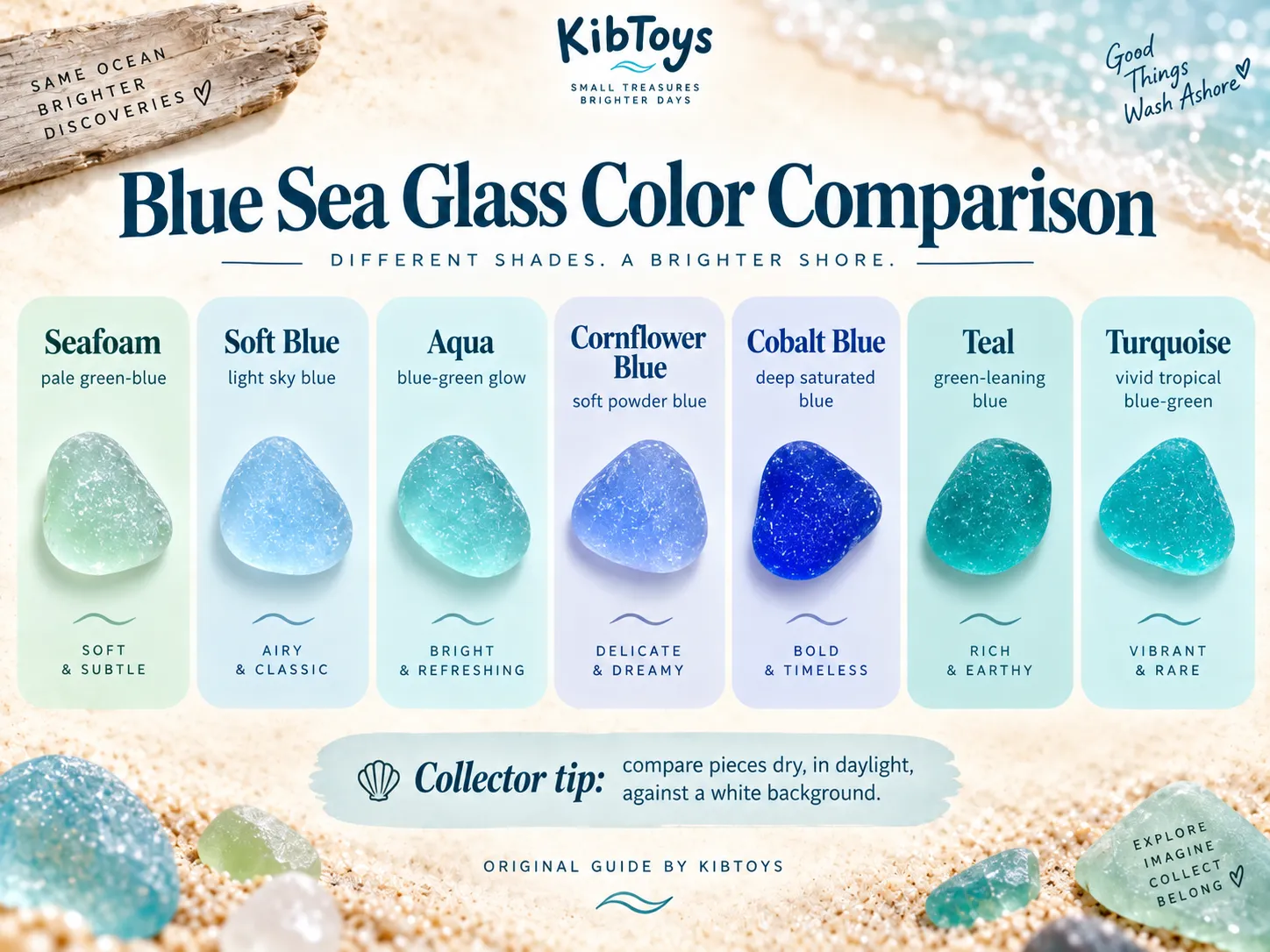
Aqua, pale blue, blue-green and seafoam can shift dramatically depending on lighting, background and whether the glass is wet.
Compare pieces dry, in neutral daylight, against white, rather than naming them from a dramatic sunset photograph.
Aqua glass has historic associations with bottles, jars, insulators, mineral-water containers and medicine bottles.
Rare Sea Glass Colors
Cobalt Blue
Cobalt is one of those colors capable of stopping a collector mid-sentence.
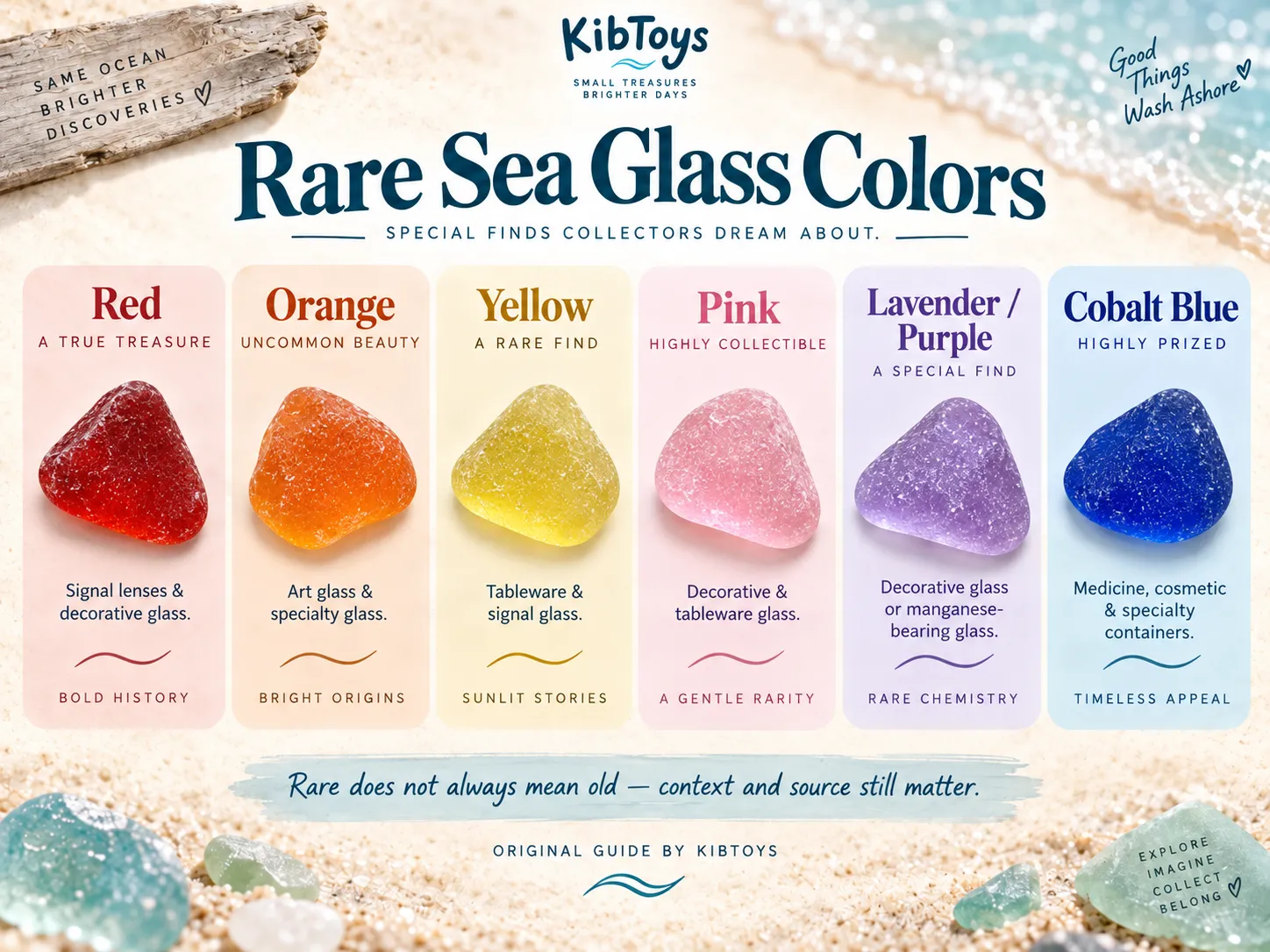
Historically, cobalt-blue glass appeared in medicine, cosmetic, poison, decorative and specialty containers. Because those products were not manufactured on the same scale as ordinary beverage bottles, cobalt tends to be much less common.
But blue is not one rarity.
Soft blue, cornflower, cobalt, aqua, teal and turquoise should not be tossed into the same bucket—figuratively or literally.
Lavender and Purple
Purple deserves a little more caution than many internet charts give it.
Some purple glass was intentionally manufactured as purple or amethyst glass. Other glass originally appeared colorless because manganese was used as a decolorizer; prolonged light exposure can cause manganese-bearing glass to develop a lavender or amethyst tone.
Historical archaeology confirms this solarization phenomenon, but also shows that manganese use spans different periods and applications. Therefore:
purple color alone is not a reliable “made before 1915” stamp.
History, manufacturing clues and context still matter.
Pink and Citron
Pink frequently traces back to tableware or decorative glass, while citron and unusual yellow-green shades may have origins in specialty containers and household glass.
These colors tend to be far less common than everyday bottle shades and are worth a closer look when they appear.
Very Rare Sea Glass Colors
Red
Red glass was used for items including signal lights, automotive and marine lenses, lamps, tableware and decorative glass.
It appears far less frequently than everyday container colors, which explains its collector status.
A good genuine red piece deserves a small celebration.
Interpretive dance is optional.
Orange
Orange is repeatedly cited by collectors and historical sea-glass references as one of the rarest standard colors.
It was never used in ordinary commercial bottles on anything approaching the scale of clear, brown or green glass. Decorative objects, art glass and signal/reflector glass are among its possible origins. Smithsonian's profile of experienced collectors likewise described orange as exceptionally scarce.
Yellow, Teal and Turquoise
All three can land in exceptionally rare territory, but naming matters.
A piece called “turquoise” by one seller might be “aqua” to another collector. That is why photographs taken beside reference colors are more useful than increasingly poetic names such as Caribbean Mermaid Lagoon Blue.
Lovely name. Terrible scientific standard.
Near-Black Sea Glass
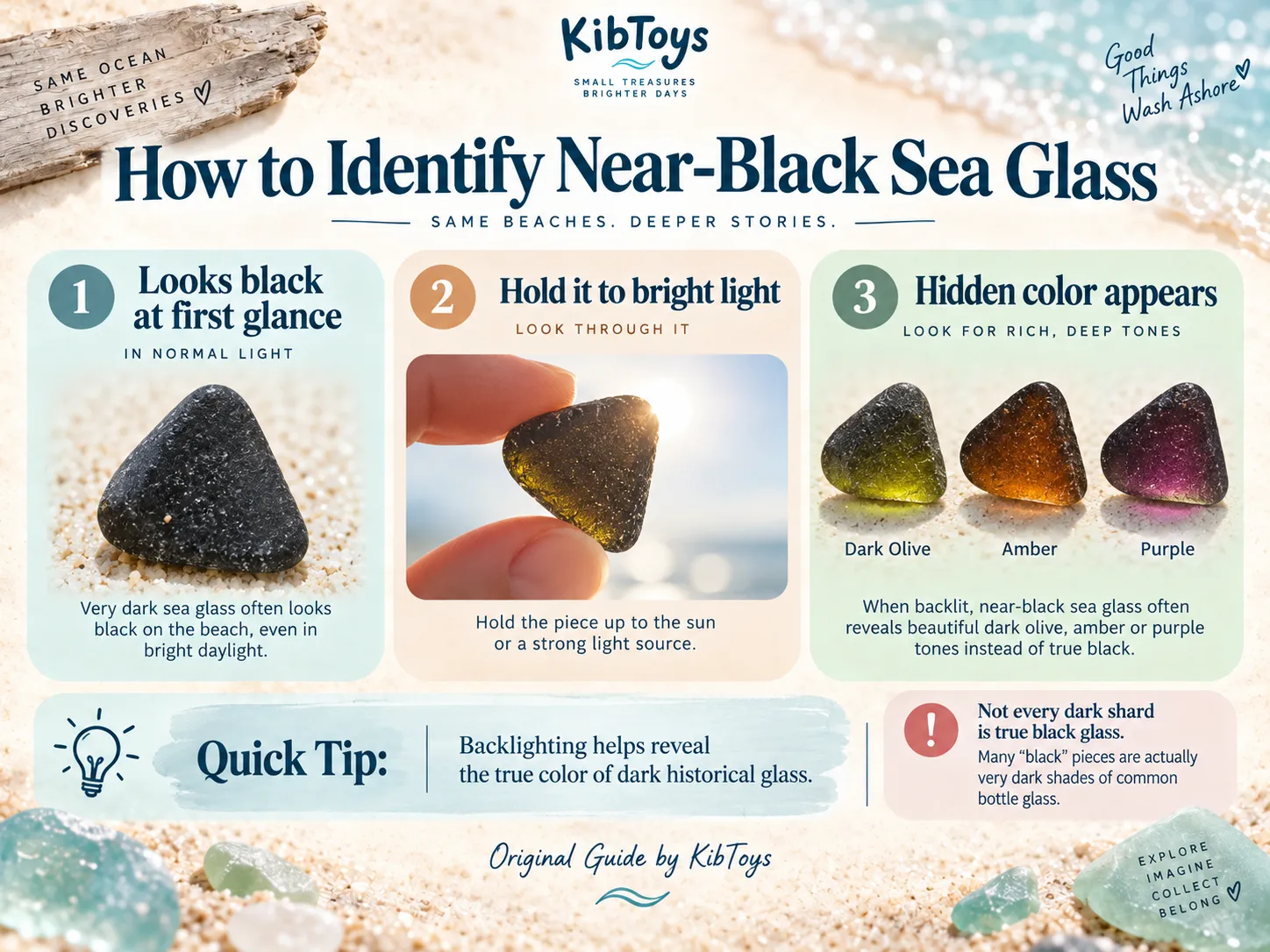
Some so-called black sea glass is not truly black at all.
Historic bottles were sometimes made from extremely dark olive or amber glass. A thick fragment can look pitch black until held against a strong flashlight or the sun, when its hidden color suddenly appears.
Backlighting should therefore be one of your first tests for a mysterious dark piece.
And no, a dark shard does not automatically prove that a pirate drank rum from it.
History is usually less cooperative than Etsy titles.
Why Sea Glass Rarity Changes from Beach to Beach
Imagine two coastlines.
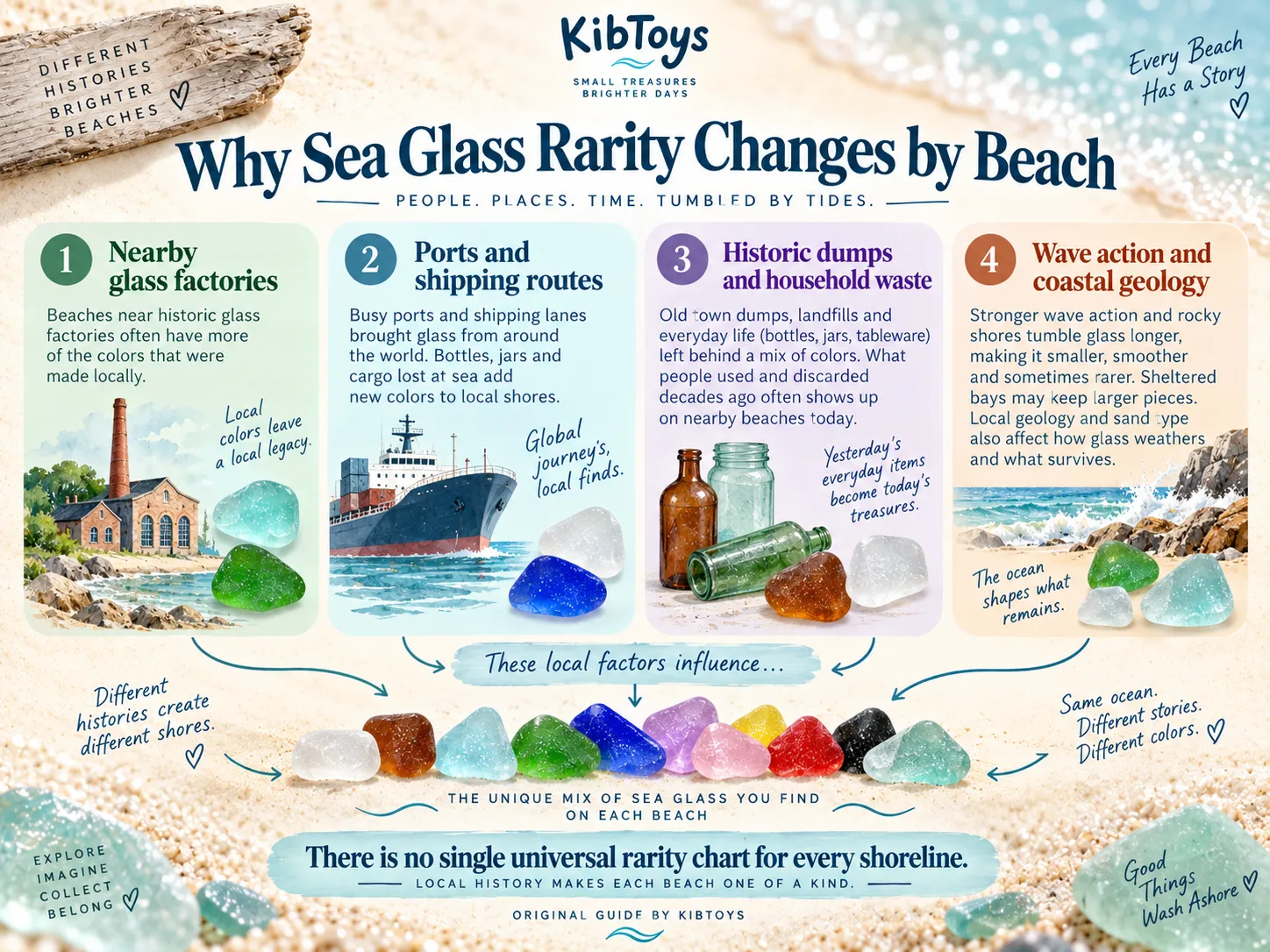
Beach A once sat near a huge beverage industry.
Beach B sat downstream from an old glassworks producing decorative colored glass.
A global rarity chart might call certain colors rare, but Beach B could produce a surprising number of them simply because thousands of scraps of that particular glass entered the local environment.
That is why serious collectors repeatedly emphasize regional rarity.
Four factors matter most:
- What glass was historically produced nearby
- What people used and discarded locally
- Ports, shipping routes, dumps and industrial activity
- Coastal geology and wave movement
Your own collection can eventually become a miniature rarity chart for your local beach.
That is more useful than pretending Miami, Seaham, California and the Great Lakes all share one universal vending machine beneath the waves.
How to Identify Sea Glass Color Correctly
Before declaring a piece “ultra-rare,” use this five-step collector check.
1. Let it dry.
Wet glass appears darker and more saturated.
2. Use daylight.
Warm indoor lighting can turn pale green into yellow or aqua into teal.
3. Compare it with known colors.
A white background and several reference pieces make subtle differences easier to see.
4. Backlight dark glass.
Apparently black material may reveal olive, amber or purple.
5. Check authenticity separately from color.
Rare color does not prove genuine sea glass.
The International Sea Glass Association notes that naturally weathered pieces often show frosting, small surface marks, rounded edges and other irregular features, while manufactured imitation glass may be suspiciously uniform in shape, finish and color. It also stresses that authentication from photographs alone can be difficult.
Examples: Reading Three Finds
Find A: A Deep Cobalt Curved Fragment
It is heavily frosted, has rounded edges and retains part of a curved wall.
What you can reasonably say:
Cobalt is a relatively rare color and was historically used for medicine, cosmetic and specialty containers.
What you cannot say:
“This was definitely a 1903 poison bottle.”
Not without more evidence.
Find B: A Pale Lavender Piece
The color becomes clearer in daylight and looks evenly distributed through the glass.
Possible explanations include intentionally colored glass or manganese-bearing glass altered by light exposure.
Look for additional manufacturing clues before assigning a date.
Find C: A Piece That Looks Black
Hold it over your phone flashlight.
Suddenly: dark olive green.
Congratulations. Your “black glass” just confessed.
The piece may be historically interesting, but shape, thickness, manufacturing marks and provenance are still required before making stronger age claims.
Common Myths About Sea Glass Rarity
“Red is exactly one in 5,000 and orange is exactly one in 10,000.”
Those figures are widely repeated as collector rules of thumb, but they should not be treated as universal statistical probabilities.
Your beach did not sign that contract.
“Rare color automatically means valuable.”
No.
Value can also depend on authenticity, size, shape, frosting, condition, historical markings, provenance and buyer demand.
“Purple always means extremely old glass.”
Not necessarily.
Purple may come from originally colored glass or from solarized manganese-bearing glass, and manufacturing history is more complicated than one cutoff year.
“Black sea glass is pirate glass.”
Sometimes dark historical glass can indeed be old.
That does not prove Blackbeard personally misplaced it.
“A seller has dozens of identical red pieces, so they must know a fantastic beach.”
Maybe.
Or maybe they know a fantastic rock tumbler.
Large batches of unusually consistent rare colors deserve additional provenance checks. ISGA specifically recommends caution when buying sea glass online and emphasizes seller transparency.
Related Questions
Is cobalt blue sea glass rare?
Generally yes. It is substantially less common than standard white, brown and green glass, although abundance varies by location.
Is aqua the same as turquoise?
Not in most collector systems. Aqua is usually paler and closer to blue-green, while turquoise tends to be more saturated.
Does sea glass change color in the ocean?
Weathering strongly changes surface appearance. Some historical glass can also undergo color changes related to its chemical composition and prolonged exposure, but you should not assume every unusual color was created by seawater.
Does rarity tell me how old my sea glass is?
No. Rarity and age overlap sometimes, but they are different questions.
FAQ
Q: What is the rarest sea glass color?
A: Orange is commonly cited among the rarest standard sea-glass colors, with red also exceptionally scarce. Exact rarity varies by location.
Q: What are the most common sea glass colors?
A: Frosted white/clear, brown and kelly green are generally the most common worldwide because clear and beverage glass was manufactured in enormous quantities.
Q: Is purple sea glass rare?
A: Yes, purple and lavender are generally considered rare. Possible sources include intentionally colored decorative glass and manganese-bearing glass that changed color after prolonged light exposure.
Q: Is black sea glass rare?
A: Very dark sea glass is comparatively rare. Some pieces described as black are actually extremely dark olive, amber or purple glass, so always examine them under strong transmitted light.
Q: How can I tell whether rare sea glass is real?
A: Look at frosting, rounded edges, irregular surface wear, shape variation and manufacturing clues, but do not rely on any single test. Provenance and seller transparency matter, especially when purchasing rare colors online.
Q: Does rare sea glass always cost more?
A: Not necessarily. Color is only one part of collectibility. Condition, size, shape, authenticity, historical clues and provenance can matter just as much.
Author
Jackson — Founder of KibToys
Jackson founded KibToys around a lifelong affection for cute, unusual, satisfying and conversation-starting objects—the sort of things that somehow take over an entire desk when nobody is watching.
The KibToys Sea Glass Library explores the stories, identification, collecting and creative possibilities behind one particularly strange category of small treasure: ordinary human-made glass transformed by years of water, movement and time.
Reviewed
KibToys Editorial Fact Check
This article was source-checked against established sea-glass collector organizations, specialist publications and historical-glass references.
No proprietary KibToys field-frequency dataset currently exists, so this article deliberately does not present editorial estimates as measured scientific statistics.
Published: September 21, 2026
Last Updated: September 21, 2026
References
International Sea Glass Association — Genuine vs. Artificial: Know the Difference
Beachcombing Magazine — The Colors and Rarity of Sea Glass
Beachcombing Magazine — The Rarity Chart – Dissected
Beachcombing Magazine — The Ever-Elusive Red Sea Glass
Smithsonian Magazine — Sea Glass: The Search on the Shore
Bill Lockhart — The Color Purple: Dating Solarized Amethyst Container Glass, Historical Archaeology 40(2)